

Your retirement date can evoke a multitude of emotions. Your last day of work may make you feel excited, nervous, nostalgic, or a combination of all three. You may not be thinking about strategically choosing your retirement date.
As a Chevron employee, you should be aware of the impact various savings and investment options have on your retirement planning. Your Chevron Retirement Plan (CRP) Lump Sum pension is one of the many tools at your disposal.
You should be aware and knowledgeable regarding the way your CRP Lump Sum is distributed, so you can make a wise, strategic decision regarding the date you select to start the pension. In some cases, adjusting your date by a few weeks can make a significant financial impact when it comes to the total pension amount to be distributed.
Chevron Retirement Plan Pension Calculation: How Does it Work with Segment Rates?
Based on your benefit start date, years of service and final average compensation. Additionally, the IRS regularly releases spot segment rates that are used to calculate the CRP Lump Sum.
Your CRP Lump Sum — “your pension” — is not solely based on interest rates. However, looking at recent interest rates over time can give you an idea of how your lump sum will be affected in the calculation and better educate your decision on when to retire.
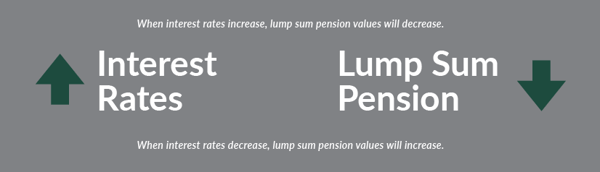
Interest rates have an inverse relationship with a lump sum pension. When interest rates increase, lump sum pension values will decrease and vice versa.
How Does Chevron Calculate the Total Amount of Pension Funds You Should Receive?
While the calculation is fairly complex, the following charts can provide you with an idea of the rates used to calculate your CRP Lump Sum and how they can affect the overall pension funds available to you.
When Chevron employees elect the month they would like to begin their pension, Chevron looks back three months to calculate the rate used for the pension disbursement.
For example, if you are planning to retire and start your pension in November 2026, Chevron would use the blended rate available through August 2026 (three months prior to your month of retirement). This example shows three months of rates and how they are blended to determine your rates for various segments of your pension. In this example, we'll look at someone who wanted to start their pension in July.
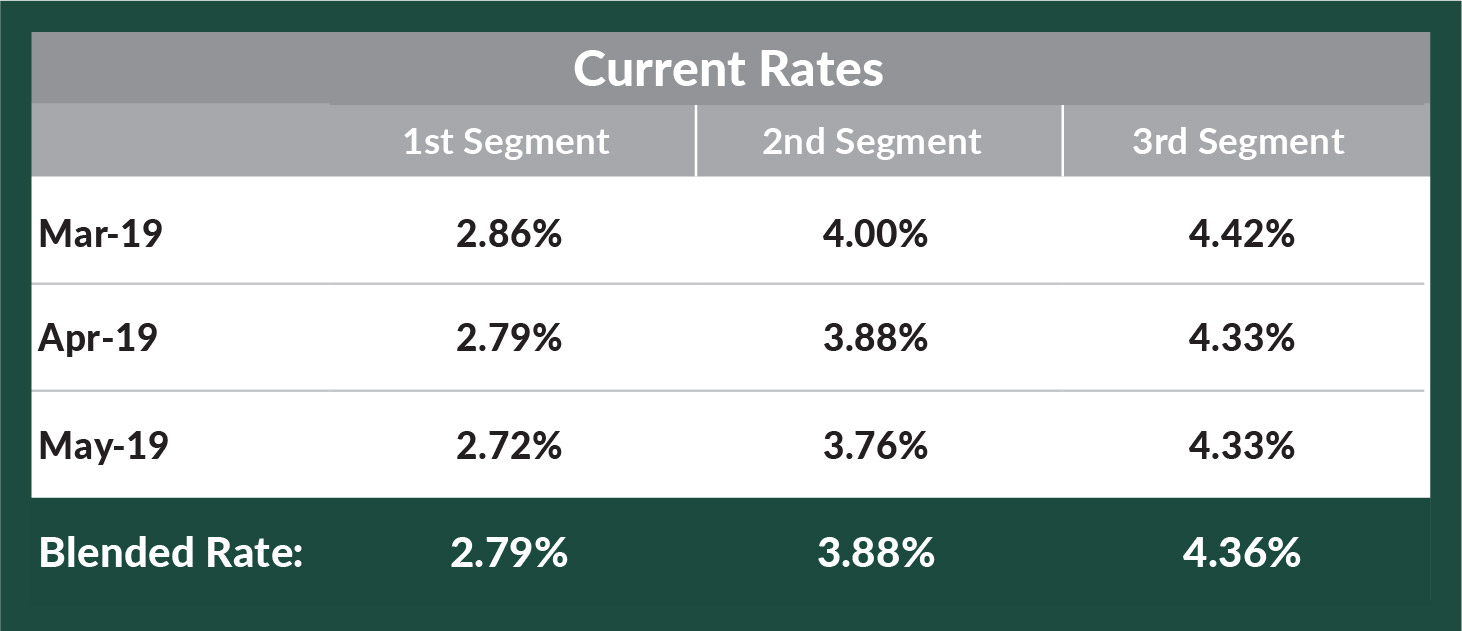
In our July 2026 retirement example, the average of April 2026, March 2026, and February 2026 rates comprise the blended rate.
The segments refer to distinct periods of pension distribution:
- The first segment rate is used to discount (calculate the present value) the first five years of pension cash flow.
- The second segment rate is used to discount years six through 20 of pension cash flow.
- The third segment rate is used to discount years 21+ of pension cash flow.
Together, these rates and terms are used to calculate the lump sum pension value.
How Might Recent Interest Rates Affect Your Chevron Pension Lump Sum?
Because pension pricing is based on interest calculations, making a slight adjustment in your Benefit Commencement Date may have a significant financial impact on your pension.
As a basic example, consider the following scenario:
- Your single life annuity pension amount is $10,580/month.
- You retire at 65.
- The life expectancy Chevron uses to calculate your pension is age 85.
Based on this information and the segment rates above, your expected lump sum pension value would be approximately $1.79 million if you started your pension in July of 2026.
However, your pension calculations will shift depending on the month you choose to start your pension. As a comparison, if you decided to start your pension in May 2026 (just two months earlier than the July 2026 scenario), Chevron would use the segment rates through February 2026.
Those rates look back on the time period from December 2025 through February 2026:
.png?width=600&height=338&name=June%2024%20Chev%20(1).png)
Disclosures: This chart is for illustrative purposes only and contains hypothetical examples designed to demonstrate the potential impact of interest rate environments on pension calculations. Actual outcomes will vary based on individual plan provisions, segment rates published by the IRS, and retirement dates. This is not a guarantee of future results, and it should not be relied upon as financial advice. Past rate trends do not predict future rate movements. Please consult your plan administrator or a qualified financial professional before making any retirement decisions.
In this instance, the lump sum increases to approximately $1.81 million.
That’s a difference of approximately $18,997 by retiring two months early.

Disclosures: This chart is for illustrative purposes only and contains hypothetical examples designed to demonstrate the potential impact of interest rate environments on pension calculations. Actual outcomes will vary based on individual plan provisions, segment rates published by the IRS, and retirement dates. This is not a guarantee of future results, and it should not be relied upon as financial advice. Past rate trends do not predict future rate movements. Please consult your plan administrator or a qualified financial professional before making any retirement decisions.
The pension lump sum value increased for a May 2026 retirement because of the decrease in segment rates that was factored into the blended rate equation. (Remember, when segment rates increase, your pension lump sum value decreases.)
Let's consider a different example from a hypothetical higher interest rate environment a year from now. Suppose you decided to start your pension in July 2027. For this example, the numbers shift slightly given the extra year of service to look like this:
- You retire at 66, after 35.5 years of service at Chevron.
- Your single life annuity pension amount increases to $10,886/month because of the additional year of service.
- The life expectancy Chevron uses to calculate your pension stays the same – age 85.
For this hypothetical July 2027 retirement, the rates may look something like this:

Using the same calculation from the previous example with our updated considerations, the hypothetical expected lump sum pension value in July 2027 would be approximately $1.76 million.
If you chose to retire 12 months earlier with lower interest rates, in July 2026 rather than July 2027, you could have earned an additional $37,000 in your CRP payout.

Disclosures: This chart is for illustrative purposes only and contains hypothetical examples designed to demonstrate the potential impact of interest rate environments on pension calculations. Actual outcomes will vary based on individual plan provisions, segment rates published by the IRS, and retirement dates. This is not a guarantee of future results, and it should not be relied upon as financial advice. Past rate trends do not predict future rate movements. Please consult your plan administrator or a qualified financial professional before making any retirement decisions.
Why? It all comes down to interest rates. Depending on your pension numbers, the changes in interest rates may have a significant impact on the lump sum value you receive in retirement and could impact your overall retirement planning.
What are the 6 Most Common Chevron Retirement Mistakes?
Find out here.
How Should Your Chevron Pension Fit Into Your Retirement Investment Strategy?
Your Chevron Retirement Plan pension accrues during your employment at Chevron and provides a retirement benefit that should be evaluated alongside your savings and investment vehicles, including your Chevron ESIP (Employee Savings Investment Plan), taxable investment accounts, Roth assets, deferred compensation, and future cash flow needs. While your pension may feel separate from the rest of your portfolio, it should not be viewed in a silo.
Because your pension is designed to provide a stable income in retirement, it may serve as an additional bucket of fixed-income funds within your broader retirement portfolio. Once your pension is included in the investment picture, your portfolio allocations may look a bit different than you expect.
Your Pension's Impact on Your Investment Allocation
One of our clients, let's call her Jana, had $900,000 in her Chevron ESIP 401(k) and $400,000 as her projected pension lump sum benefit for a combined retirement portfolio of $1.3 million. She hoped to get a bit more growth in her portfolio before living off of it, so she allocated most of her investments to equities with some protection from fixed income.
Her goal: allocate her 401(k) investments so her portfolio would be a 60% stock and 40% fixed income allocation.
Seems pretty straightforward, right?
In doing so, she shifted over 55% of her complete portfolio to fixed income because of how her pension operates. Remember, the CRP pension acts as an additional bucket of fixed income and you can't control how it's invested before receiving it. Instead of taking moderate risk with her exposure to equities, she unintentionally allocated the majority of her portfolio to fixed income, not growth-oriented investments.
.png?width=637&height=358&name=Chevron%20Pension_2026_Blog%20Article_CRP%20Pension%20Pie%20Chart%20(3).png)
How to Time Your Chevron Pension Lump Sum With Interest Rates
Segment rates correlate with US Treasury rates; when Treasury rates are on the descent, segment rates will decline accordingly. And, as mentioned, lowering interest rates means a higher pension calculation. By looking back over a 12-month period and reviewing their projections, you may be able to get an idea of which direction rates will head in the future.
.png?width=637&height=358&name=SR%20%26%2010YR%20Treasury%20(1).png)
Source: Federal Reserve Economic Data, Federal Reserve Bank of St. Louis
As an example, if we continue to see rates trending downward in the coming months, that has a positive impact on pension calculations and could give you a reason to postpone your pension election date to get a larger lump sum pension payout. Time your retirement date to take advantage of the best rate/pension scenario for you.
For many executives at Chevron, taking their lump sum pension earlier in July could mean a substantially lower payout than if they decided to retire earlier in May 2026. However, interest rates could remain high or potentially increase for many months while the Fed fights inflation, so if you have flexibility in your retirement planning, it may be worth modeling whether retiring earlier or waiting until rates decline could produce a more favorable lump sum.
As you prepare for retirement, your pension is designed to provide a valuable means of ongoing support. It’s important to ensure you’re maximizing the value it provides. Our financial advisors can offer advice and feedback on your pension planning dates, as well as on additional avenues for making the most of your pension, such as tax-planning strategies. Review our process and the ways we can support you in preparing and positioning yourself for retirement.