
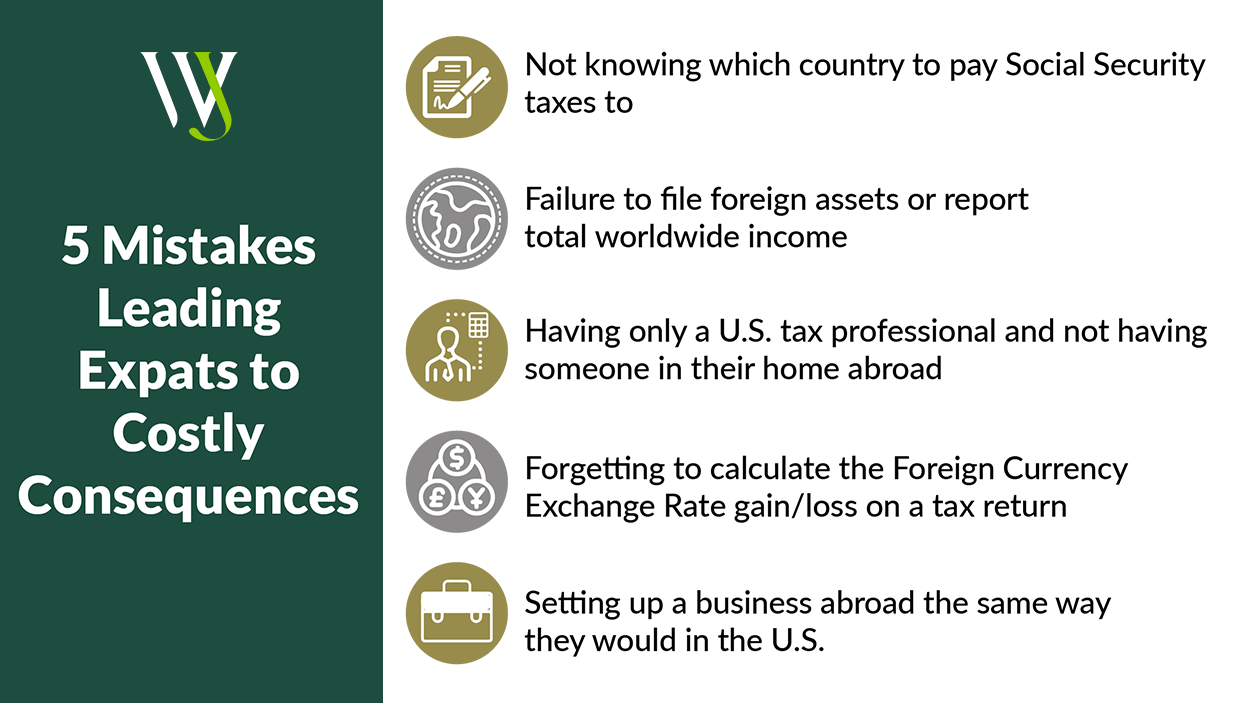
Whether you seek to retire in a lower cost environment or move as required by your employer, moving overseas as a U.S. citizen can be an exciting adventure. Amidst all the excitement and the flurry of activity, it's essential to pause, make a checklist of the critical to-do items, and begin thinking about the unique considerations that impact an expat's finances. Not tending to these details, or making the wrong decision about something, could result in costly mistakes. Before moving overseas, there are a few topics you, a U.S. citizen, should think about before the big move.
Expats Should Work With Tax Professionals In Their Home And Residing Countries
Having a team of knowledgeable tax professionals in both the U.S. and your residing foreign country is an absolute must to ensure that you comply with both countries' tax regimes and local and national laws. Lack of compliance on any level is costly to repair. You don't want to leave money on the table due to ignorance of the laws impacting U.S. expats.
Expats Must Pay Social Security Taxes
In another article, we discuss the U.S. income tax implications of working overseas and how to avoid double-taxation of your income by both countries —But what about social security taxes or self-employment tax if you are self-employed? Like the U.S., many countries also require the equivalent of social security taxes. So, how can you avoid getting taxed twice for social security?
U.S. Social Security and Medicare taxes apply to income you earn overseas if you work for a U.S. employer. The definition of a U.S. employer is a bit complicated and includes individuals who are residents of the U.S. The definition also includes trusts, partnerships, and corporations with U.S. ownership.
If you are working for a foreign corporation in the country in which you are residing, you will likely be subject to taxes that are equivalent to that country's Social Security. In many countries, this is called National Insurance.
Totalization Agreement's Impact on an Expat's Tax Bill
To determine whether you will pay US Social Security taxes or your residing country's National Insurance (or equivalent) taxes, you may have to look into whether the US and that country have a bilateral social security agreement. These agreements are known as Totalization Agreements.
The U.S. has Totalization Agreements with 30 countries. Such agreements avoid double-taxation in both the U.S. and the residing country concerning social security and Medicare taxes. A Totalization Agreement ensures that you pay social security taxes to only one country, thus eliminating dual coverage and dual contributions for the same work.
Under a Totalization Agreement, your employer (whether the U.S. or foreign employer) is required to secure a certified statement from the appropriate agency to verify which country your pay is subject to social security coverage. For U.S. employers, the Social Security Administration provides the statement, while the appropriate agency for foreign employers. This certificate should be kept by your employer because it establishes proof of which country is authorized to tax you for social security.
If you are self-employed in a foreign country, you (as your own employer) are responsible for securing the Social Security Administration certificate. More information can be found on the IRS and SSA websites, or reach out to us at WJW, and we can put you on the right path.
Legal and Tax Considerations for Self-Employed Expats
Just like the U.S., foreign companies have various legal structures through which you should operate your business. Seek a business attorney or counselor in your residing foreign country who has experience in setting up businesses. Across various countries, each business entity differs as far as legal liability and taxation. You will also need to ensure that you comply with all laws applicable to businesses within your residing country. As stated previously, you will be subject to self-employment taxes, including social security and Medicare taxes. Just like in the U.S., having knowledgeable foreign counsel will save you untold mistakes and costs navigating a terrain with which you are not familiar.
Foreign Asset Reporting & Tax Forms
Depending on how your business is legally defined, you will be required to file a reporting form with your U.S. tax return every year. For example, if the legal entity through which you are operating your business is classified with legal liability, you will be required to file a Form 5471. If the entity qualifies as a partnership, you will be required to file a Form 8865. There are additional steps you can take to simplify by becoming a disregarded entity, which would require you to file a Form 8858. There are stiff penalties for failing to file these forms, so educate yourself and consult with our team of professional advisors at WJW, who can assist you with these determinations.
As a business owner in a foreign country, you will report your income and deduct your business-related deductions. How you are set up legally will determine whether you report your income and expenses on your individual tax return or on a business-related tax return. This applies to both the US tax return and the foreign tax return, so it is vital that you have a tax team in both the US and the country in which you are residing.
Another important consideration for U.S. expats is that all foreign business and investment transactions are subject to calculating a foreign currency gain or loss. For business transactions, foreign currency gain or loss is considered a business gain or loss. If the transaction is an investment transaction, foreign currency gain or loss is treated appropriately as an investment gain or loss.

Tax Rules Regarding Foreign Real Estate Ownership
When you purchase real estate overseas, you will receive the same tax breaks as you do with U.S. real estate ownership. For a home that is your principal residence, you can deduct your property taxes and your mortgage interest.
Property Depreciation
If you purchase real estate for rental purposes, you can offset your property expenses against the rental income. Please note, for a foreign property, you must depreciate the foreign residential rental property over 30 years and commercial rental property over 40 years-- This is different from U.S. rental property depreciation.
Foreign Real Estate & the U.S. Tax Forms
Before plunging into the foreign real estate market, make sure you do your homework and find answers to the following questions:
-
- Do you need to purchase real estate through a legal business entity? If so, what are the tax implications when you sell?
- What is the equivalent in that country of a U.S. realtor? How much do they charge?
- What is the history of the property? Many properties sit on old fuel storage tanks that must require remediation to meet environmental regulations, which can be exceedingly costly.
- What are local zoning laws, environmental laws, and other laws or codes you must comply with?
- Are there any filing requirements in your residing country related to real estate? Are there property taxes, and approximately how much?
- What is the potential gain on the fluctuation in foreign currency rates?
You will want to consult a tax professional before you purchase property to determine the taxation of gain upon sale. Real estate can be personal, residential rental, commercial rental, or investment. The taxation upon the sale is different for each. Don't wait until you are ready to sell the property to know how it impacts you from both the U.S. and foreign tax standpoints.
Foreign Currency Exchange Rate Gain
When you sell foreign real estate, you must report on your U.S. tax return the gain from the sale and the foreign, or functional, currency exchange rate gain. How the gain from the sale is treated depends upon the type of real estate (whether it's a personal residence, investment, or rental). However, the functional currency exchange rate gain is the gain that catches most real estate owners by surprise.
The U.S. tax laws treat foreign currency as property rather than a medium of exchange. Considering this, when a mortgaged foreign asset is disposed of, two property types are disposed of: the actual asset and the mortgage. Let's illustrate by way of an example.
Annie is a U.S. citizen working in the United Kingdom for a UK-owned employer. She and her spouse purchased a home in the U.K. as their personal residence in January of 2010 for £375,000, which was equal to $603,750 (exchange rate 1.61). At the time of purchase, Annie took out an interest-only £350,000 mortgage from a U.K. bank, equivalent to $563,500. Annie resides there for 13 years and sells the house in July of 2024 to move back to the U.S. (exchange rate 1.242).
In 2024, the gain is calculated as follows:
|
|
In UK Pound Sterling |
In U.S. Dollars |
|
Sales Price |
£850,000 |
$1,055,700 |
|
Purchase Price |
£375,000 |
$ 603,750 |
|
Total Gain |
£475,000 |
$ 451,950 |
For U.S. tax purposes, the gain qualifies for the principal residence gains exclusion and is not taxable. However, be aware that the gain is considered foreign-sourced income, which will impact the foreign tax credit calculation on Form 1116. If Annie had sold rental or investment real estate instead, the gain would have been taxable.
Now, let's continue this example to compute the foreign currency exchange rate gain.
Annie financed the U.K. home's purchase with an interest-only mortgage of £350,000, which translated to $563,500 due to an exchange rate of 1.61. At the time of sale, this same mortgage was equivalent to $434,700 due to an exchange rate of 1.242. The IRS views that Annie received value at the time of mortgage of $563,500, which she had only to repay $434,700 10 years later.
The difference of $128,800 is entirely due to fluctuations in the currency exchange rate and is considered taxable income in the U.S. This gain is regarded as ordinary income instead of capital gain; therefore, preferential capital gain rates do not apply to this gain.
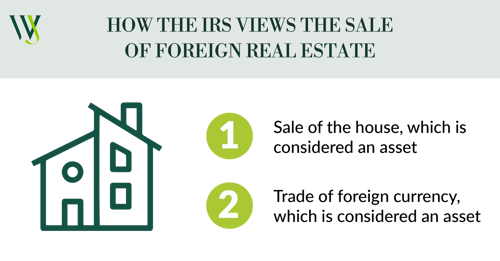
Each time a foreign mortgage amount is reduced, you must perform this gain calculation, whether making monthly payments on the mortgage, paying off the mortgage, or refinancing the mortgage.
And as a heads up—if the calculation goes the other way and results in a loss, you cannot deduct the loss on a U.S. tax return; for example, when personal assets (like a principal residence) result in a loss from the exchange rate calculation, it is considered a personal loss.
These are just a few issues to consider when moving overseas as a U.S. citizen. The importance of teaming up with quality accountants and attorneys on both sides of the pond cannot be over-emphasized. If you have questions, contact our team at Willis Johnson Wealth. We will put you on the right path to finding quality advisors to help protect your assets.