
Many of Shell’s high-income-earning executives don’t fully understand the differences between their numerous benefits, especially those related to their pension. Many who have spent their entire careers at Shell improperly manage the timing of their retirement, which impacts the calculation for their 80-Point Pension Benefit Restoration Plan. Poor retirement timing decisions often produce one of two results:
- The executive chooses a date that has significant tax consequences, or
- The executive chooses a payout date and elections that can cost them tens to hundreds of thousands of dollars, especially for those planning on retiring in the near term.
To learn how to avoid these costly mistakes and get the most from these two plans, let’s dive into the details and payout considerations so you can be fully equipped when the time comes to make your elections for each.
Understanding the Differences Between Your 80-Point Pension & the Pension’s Benefit Restoration Plan (BRP)
Shell 80-Point Pension
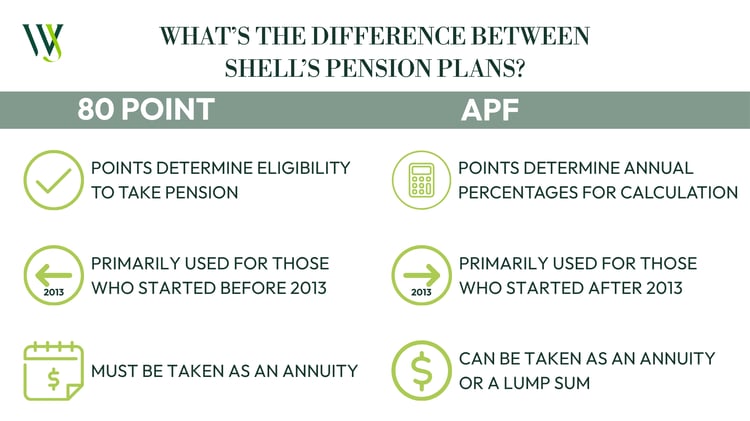
Many of our Shell clients are familiar with the 80-Point Pension the company offers. This defined benefit retirement plan uses your age, years of service, and average final compensation to determine a payout amount that Shell will pay you in your retirement. The Shell 80-Point Pension must pay out as an annuity.
Shell 80-Point Pension Benefit Restoration Plan (BRP)
If you are a highly compensated employee of Shell Oil and are on the Shell 80-Point Pension, Shell is likely making separate contributions to the Shell 80-Point Pension BRP on your behalf. The 80-Point Pension BRP is a non-qualified plan that allows Shell to restore benefits that an employee loses because of pension contribution limits set by the IRS each year.
Payout Differences Between the 80-Point Shell Pension & the Shell 80-Point Pension BRP
While you must take your Shell 80-Point Pension as an annuity, your 80-Point Pension BRP is distributed as a lump sum. When you retire, Shell pays your 80-Point Pension BRP as a lump sum approximately 90 days after your retirement date (or six months if you are considered a key employee). If your BRP includes “Old Money” contributions, those are typically paid as an annuity, but we’re seeing fewer of those over time.
Learning how these benefits pay out upon retirement is a crucial step in retirement planning. Learn more here >>
How to Calculate the Shell 80-Point Pension Benefit Restoration Plan (BRP)
Most of our Shell clients do not realize that recent interest rates can impact the value of their employee benefits for retirement. Specifically, Shell uses the segment rates from September each year to calculate the Shell 80-Point Pension Benefit Restoration Plan (BRP).
To determine the value of the 80-Point Pension BRP lump sum, we sum all future theoretical BRP annuity payments over the employee’s estimated life expectancy and discount them at the applicable interest rate (in this case, the September segment rates). Thus, the lump sum value is simply the present value of future estimated monthly BRP annuity payments as a one-time summation. Here’s an example of this calculation:
PV = (PMT1/(1+r)1) + PMT2/(1+r)2 … PMTN/(1+r)N
PV = Present Value or “Lump Sum Value” in today’s dollars
PMT = Projected annuitized payment amount
R = Discount Rate or “Segment Rate”
N = Number of Years remaining in life expectancy
When calculating the lump sum payout for the Shell 80-Point Pension Benefit Restoration Plan (BRP), Shell uses the September segment rates from the previous year.
If you retire before the end of November 2026, Shell will use the September 2025 rates because the calculation takes place one month after your retirement date (sometime in December 2026). However, if you retire December 1st, the calculation takes place in January 2027 and will use September 2026 rates.
What are Segment Rates and How Do They Impact The Lump Sum Payout of the Shell 80-Point Pension BRP
Segment rates are rates provided by the IRS that companies use to determine specific payout amounts for employee deferred compensation plans, like pensions or non-qualified plans. Segment rates are highly correlated to the movement of interest rates for short, medium, and long-term bonds respectively.
Interest rates eased in the second half of 2025 as the Federal Reserve began cutting rates again. Still, by September 2025, rates moved again to offset cooling inflation and stayed near 5% by year-end. This shift in segment rates plays a significant role in Shell professionals' BRP lump sum calculation.
Discover Stock Market Trends & Economic Analysis in our Recent Stock Market Update Here >>
To illustrate the impact of these rate movements, we can compare 2025 and 2026 rates, even though we haven’t received September rates from the IRS yet. Let's take a look at what we’ve seen up until now:
| Segment Rates from September 2025 to August 2026 | |||
| Month/Year | 1st Segment | 2nd Segment | 3rd Segment |
|
September 2025 |
4.06% | 5.12% | 5.93% |
|
August 2026 |
4.65% | 5.75% | 6.73% |
|
Shell uses the September segment rates when calculating an employee's BRP payout. The August rates listed above are for modeling purposes only to show the year-to-date trend in rates. Refer to the Shell benefits books for additional information. |
|||
Source: https://www.irs.gov/retirement-plans/minimum-present-value-segment-rates
Note, lower interest rates mean a higher value for your Shell 80-Point BRP Pension lump sum.
Additionally, the 10-year treasury rates for September often act as leading indicators of where segment rates are headed. From August 2026 to September 2026, they increased by 50 basis points!
If we apply that increase to what we expect to see in segment rates for September 2026, our rates could look something like this:
| Segment Rates Impacting a Shell 80-Point BRP Pension Lump Sum Payout | |||
| Month/Year | 1st Segment | 2nd Segment | 3rd Segment |
|
September 2025 |
4.06% | 5.12% | 5.93% |
|
September 2026 |
5.15% | 6.25% | 7.23% |
| September 2026 segment rates are hypothetical examples based on the 50-basis-point increase in 10-year Treasury yields from August to September 2026. Actual rates are posted by the IRS and may vary. | |||
So, how can changing your retirement date from November of one year to December of the same year affect your payout, given the movement in segment rates?
Differences in BRP Pension Payouts in November vs. December 2026
Shell Lump Sum Pension BRP Payout Example for November 2026 Pension Elections
Let’s consider an example of a Shell employee who chooses to retire in November 2026.
a) 60-year-old retiring November 1, 2026
b) Pension starting December 1, 2026
c) Average Final Compensation is $725,000
d) Thirty Years of Service with Shell
e) The value of both the traditional 80-Point Pension and Pension BRP is worth $29,000/month
f) NetBenefits shows a traditional 80-Point Pension of $14,400/month
g) Life Expectancy is 83.2 years
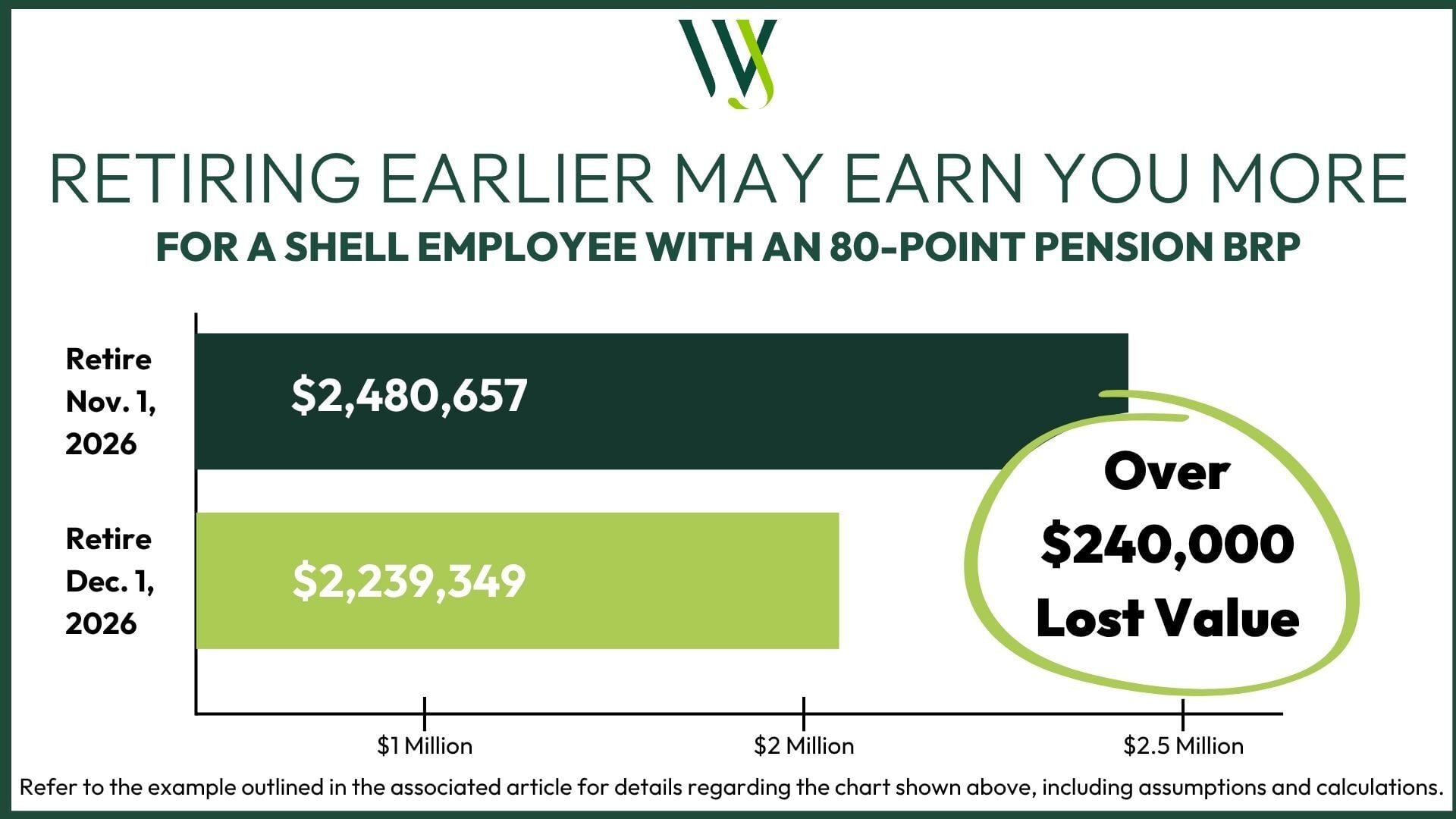
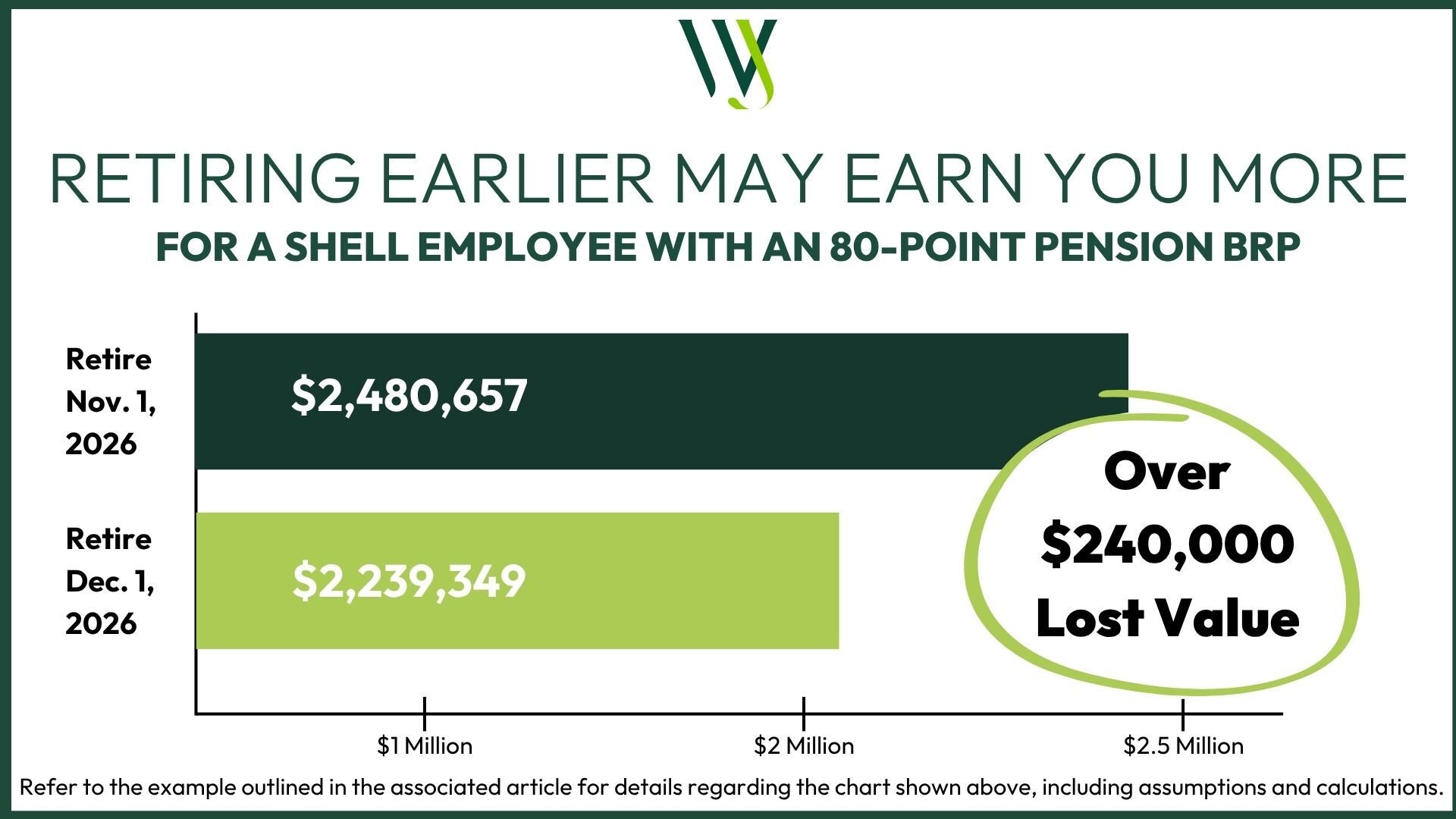
If we run the example with a November 1, 2026 retirement date and a pension start date of December 1, 2026, Shell will use the segment rates from September 2025. The September 2025 segment rates were 4.06%, 5.12%, and 5.93%. In this scenario, the lump-sum value for a December 2026 pension BRP election is approximately $2,480,657.
Shell Lump Sum Pension BRP Payout Example for December 2026 Pension Elections
Let’s fast forward and assume you want to retire at year-end.
In 2026, rates have been climbing all year. Inflation picked back up, fueled partly by rising oil prices, and in September the Fed raised interest rates for the first time since 2023. By August, all three segment rates were up 0.6 to 0.8 percentage points from last September, and early signs point to September’s rates coming in even higher than August’s. This shift in segment rates greatly impacts the lump sum calculation even if no other factors change.
For this example, we’ll change the Shell employee’s retirement date to just one month later than in the previous example. For modeling purposes, we’ll use the hypothetical rates we showed earlier, since September’s rates won’t be released until later this year.
As a recap, the 10-year Treasury rates came in 50 basis points higher than August’s rates, so we’ll project that same 50 basis point increase on August’s published segment rates for this example.
a) 60-year-old retiring December 1, 2026
b) Pension starting January 1, 2027
c) Average Final Compensation is $725,000
d) Thirty Years of Service with Shell
e) The value of both the traditional 80-Point Pension and Pension BRP is worth $29,000/month
f) NetBenefits shows a traditional 80-Point Pension of $14,400/month
g) Life Expectancy is 83.2 years
If we run the math on the above example using our hypothetical rates as our stand-in until we receive September 2026 rates, then the value of the lump sum BRP Pension based on a January 1, 2027 pension commencement date is worth around $2,239,349.
That's a difference of over $240,000!
Why the vast difference? Let’s briefly walk through the math to roughly estimate the value of the BRP Pension lump sum.
Essentially, it comes down to the basic time value of money. First, we must calculate a sum of all future theoretical 80-Point Pension BRP annuity payments over the employee’s estimated life expectancy. Then, we discount that sum by the applicable rate (segment rates). This calculation gives us a lump sum value equivalent to these theoretical annuity payments. Remember, the 80-Point Pension is taken as an annuity, but the 80-Point BRP Pension must be taken as a one-time lump sum payment.
PV = PMT1/(1+r)1 + PMT2/(1+r)2 … PMTN/(1+r)N.
PV = Present Value or “Lump Sum Value” in today’s dollars
PMT = Projected annuitized payment amount
R = Discount Rate or “Segment Rate”
N = Number of Years remaining in life expectancy
For our November 2026 example, an overly simplified version of this equation might look something like this:
$2,480,657 = (14,600)1 / (1+4.06%)1 + (14,600)2 / (1+5.12%)2 … (14,600)23.2 / (1+5.93%)23.2
The subscripts reflect each year remaining in the individual’s life span, and the calculation is run per month in each year over the 23.2 years used to calculate the lump sum.
Remember, as interest rates go up, the pension value will decrease, and vice versa.
Looking ahead, segment rates could continue to rise into 2027. Inflation has climbed back to 3.4%, driven largely by oil prices topping $100 a barrel amid conflict with Iran, and in September the Federal Reserve raised interest rates for the first time since 2023. As a result, long-term borrowing costs are at their highest since 2007, and segment rates generally follow them. Shell professionals should watch these rates to make informed decisions about when to start their pension and receive BRP payouts without leaving money on the table.
Understanding the impact of appropriately timing your Pension BRP payout can significantly affect your retirement income. Still, another dark horse to keep in mind when planning your finances is taxes.
Tax Impact of Your 80-Point Pension Benefit Restoration Plan Payout
The Shell 80-Point Pension Benefit Restoration Plan is a non-qualified pension plan, meaning it does not receive the same preferential tax benefits as your qualified pension, the Shell 80-Point Pension.
The Shell Pension BRP is taxed immediately at distribution, meaning most retirees receive the Shell 80-Point Pension BRP within 90 days of retirement and pay taxes immediately. You cannot roll your pension BRP into your 401(k) or IRA. Additionally, you cannot elect to defer receiving proceeds from your Pension BRP over time (unless you have an Old Money contribution or made benefit elections before 2007).
See an Example of How Retirement Timing Could Reduce Taxes by $50,000 >>
Who Can Benefit from This Shell 80-Point Pension BRP Strategy?
For Shell employees considering retiring within the next 18 to 24 months, or those who can retire earlier, reviewing segment rates to maximize your 80-Point Pension BRP payout can be a great strategy.
We help Shell clients planning to retire in the next couple of years analyze today’s segment rates and make an informed election decision based on their situation. Don’t overreact if you are looking at retiring in two to five years or are concerned about how rising rates may affect your Pension BRP payout. Your pension value will likely keep increasing if you work longer, and no one knows exactly how rates will change over time.
This strategy may not fit those taking voluntary severances, as Shell may require a specific termination date, and the severance may be substantial.
Before you make any decision, we recommend you work with a fiduciary financial advisor and seek confirmation about your various pension benefits and choices from Shell HR. Many Shell employees have different pension rules due to acquisitions, U.S. citizenship, being on the APF pension plan instead of the 80-Point, and other factors. So, confirm how your retirement date affects your pension BRP before you decide. Of course, taxes, other financial assets, personal goals, and financial needs all come into play. That’s why we do a comprehensive assessment with our clients instead of focusing on just one item.
If you have questions about your Shell benefits and want a second opinion, contact one of our advisors who specialize in helping Shell employees make the most of these retirement savings tools.