
Between rising Medicare premiums and recent tax law changes, high-income retirees face more obstacles than ever before in navigating how to use their required minimum distributions (RMDs) from IRAs. For those who are charitably inclined, utilizing a Qualified Charitable Distribution (QCD) could help lower your Adjusted Gross Income (AGI) to potentially lower IRMAA surcharges or your annual tax bill.
However, there are several ways this strategy can go wrong, so let's explore what you need to know.
Let's start with the basics.
What is a Qualified Charitable Distribution?
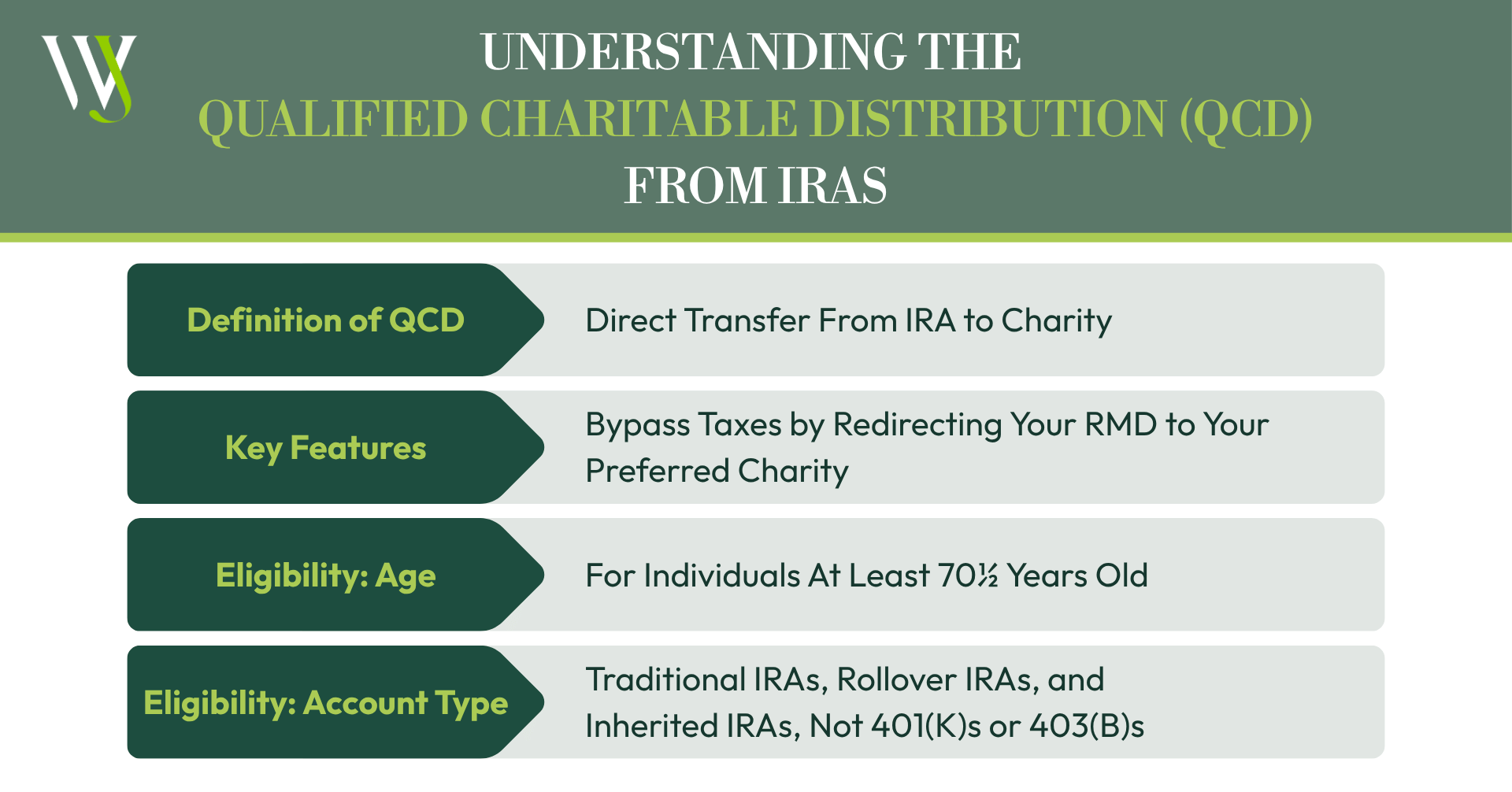
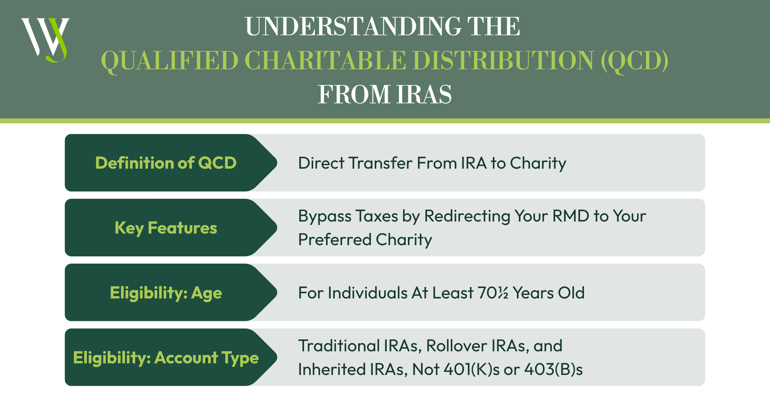
A qualified charitable distribution, under current law, allows individuals over the age of 70 ½ who are charitably inclined to send a portion of their IRA balance directly to one or more charities and have the otherwise taxable distribution excluded from the income. These distributions can count toward satisfying your Required Minimum Distribution and lower your adjusted gross income, potentially decreasing Medicare premiums and phaseouts.
Who should consider doing a Qualified Charitable Distribution?
There are several reasons why it may be important for an individual or married couple who are already charitably inclined to send their RMD directly to charity.
First, it decreases your Adjusted Gross Income (AGI). Instead of including your entire RMD in your AGI and then making a donation to charity for a deduction, you can send the amount you would have donated directly to a charity, and it will not be included in your AGI. This allows you to actually give MORE to charity because you are saving money on taxes, all while decreasing your AGI.
Second, as your AGI increases, you begin to have an increase in phaseouts on deductions as well as an increase in Medicare premiums, which then increases your taxable income. By sending a portion of your RMD directly to charity, you can attempt to avoid some of the phaseouts that occur at a higher AGI.
Consider the following hypothetical examples:
A married couple in their late 70s wishes to make a large donation to their favorite charity. Their current AGI, including $160,000 of combined RMDs, is $327,000. They make a donation of $108,000 and deduct the amount on Schedule A of their tax return.
Their total estimated Federal Income tax payment is $38,148. They will also have higher monthly Medicare premiums and will be required to pay the Net Investment Income Tax.
Additionally, their $108,000 charitable contribution will no longer be fully deductible, and they will be subject to a 0.5% AGI hurdle, meaning only $106,365 will be deductible.
If the same couple sends $108,000 of their RMDs directly to charity, their current AGI will decrease to $219,000. They will not list a charitable deduction on their Schedule A. Their total estimated Federal Income tax payment will be $28,975.
Not only are they paying less in Federal Income taxes and Medicare premiums, but they will not pay the Net Investment Income tax.
Net Investment Income Tax, and the full $108,000 value will count towards reducing taxes.
In short, a QCD can benefit those who:
- Take RMDs annually, but don't need the income from their RMD for living expenses
- Are affected by high AGI-related taxes or phaseouts due to their IRA income
- Use the standard deduction and don't itemize
- Are charitably inclined donors who give in cash, and are looking for a more efficient way to give on a recurring basis
Qualified Charitable Distributions vs. Donor-Advised Funds
Many advisors tout the benefits of both QCDs and donor-advised funds (DAFs), but while both strategies can help you contribute to charitable causes in an efficient manner, they vary widely.
For starters, QCDs are elected distributions from IRAs, while DAFs are separate funds you can contribute to. You can contribute cash or appreciated assets at any age to a DAF, but you cannot direct QCDs into a DAF.
QCDs, on the other hand, can only be elected by those age 70 1/2 and older. Lastly, contributions to a donor-advised fund are eligible for an immediate tax deduction (subject to AGI limits), while a QCD reduces AGI by redirecting the income entirely.
While QCDs cannot be made to donor-advised funds (DAFs), these vehicles can still play a role in broader charitable strategies. For example:
- Using QCDs for annual giving from IRAs
- Using DAFs for long-term or legacy charitable plans from taxable brokerage accounts.
These vehicles, as part of a coordinated financial plan, can help you give more to the causes you care about in a tax-efficient manner.
What is the Maximum Amount for Qualified Charitable Distributions?
For 2026, the limit on the amount that you can send to charity is $111,000, and the distribution must be made from an IRA, not a 401(k). The $111,000 limit is per individual, so a married couple may send over $200,000 combined to the charities fondest to them.
Following the passing of the One Big Beautiful Bill Act in 2025, QCDs are not subject to the new AGI floor (0.5%) for itemized deductions (beginning in 2026) or the 35% cap on the value of charitable deductions for high-income earners.
Incorporating Charitable Giving into Your Financial Plan
If you do decide to make a QCD, it is crucial to remember that your IRA’s custodian should make the check payable to the charity, not to you as the owner. If the check is made out to you, there is no way to correct this mistake, and the money will be deemed as part of your adjusted gross income.
Additionally, the charity must be a public charity, not a private foundation or a donor-advised fund. It is also important to note that a QCD can only be made from a Traditional IRA or an Inherited IRA where a beneficiary is over 70 1/2 years of age. You cannot make a QCD from a 401(k), it is not an eligible account.
Taking advantage of qualified charitable distributions is a tax-efficient way to lower your retirement income and pay fewer taxes, while still giving to the charity of your choice. Whether through Qualified Charitable Distributions, Donor-Advised Funds, appreciated stock donations, or other giving vehicles, the right approach depends on your unique goals, assets, and timing.
A well-structured plan can help you make the greatest possible impact for both the organizations you support and your long-term financial picture. If you’re ready to explore charitable strategies that fit seamlessly into your broader plan, consider working with a financial advisor who can help you evaluate your options and coordinate them with your overall wealth strategy.