
The IRS recently released the 2027 retirement plan contribution limits. For super-savers at Dow, things are looking up.
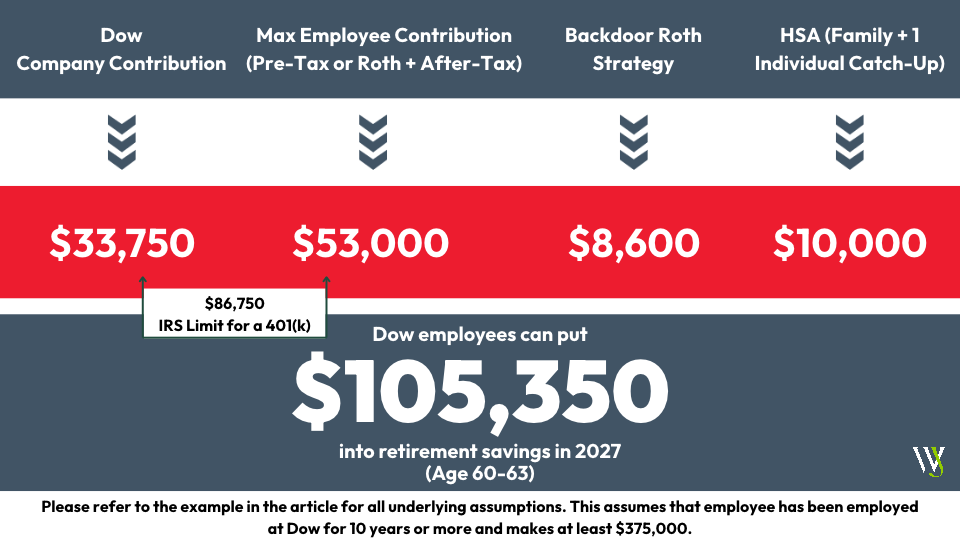
Dow employees can now contribute $25,500-$37,250, depending on their age, of pre-tax or Roth savings to the Dow Employees’ Savings Plan (ESP). This means that Dow professionals can get up to $91,500-$105,350 of retirement savings into tax-efficient vessels in 2027, depending on their age. Let's look at the breakdown:
| Source | Under 50 | Age 50-54 | 55-59, 64+ | 60-63 |
|
Fully maxing out all 401(k) sources
|
$75,000
|
$83,500
|
$83,500
|
$86,750
|
| Backdoor Roth |
$7,500
|
$8,600
|
$8,600
|
$8,600
|
|
HSA (family, +1 catch up where applicable)
|
$9,000
|
$9,000
|
$10,000
|
$10,000
|
| Total Retirement Savings | $91,500 |
$101,100
|
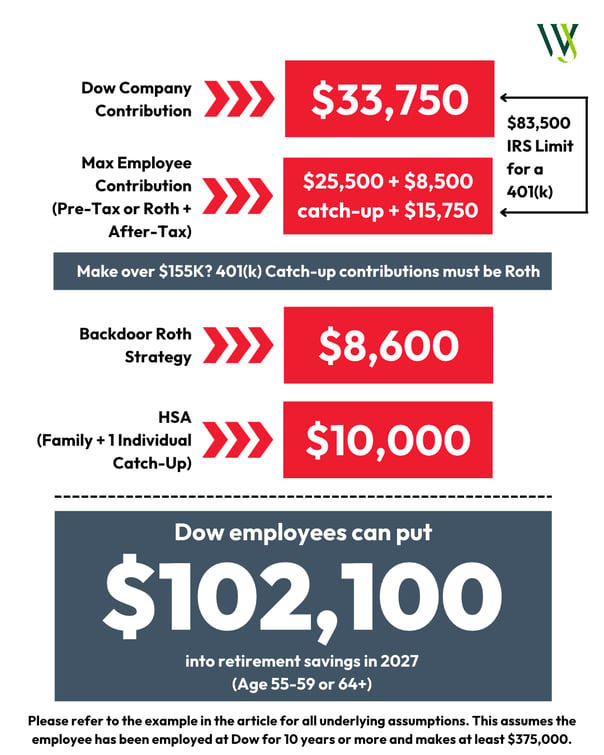
$102,100
|
$105,350
|
401(K) Contribution Limit Changes from 2026 to 2027
Contribution limits are indexed for inflation each year. To determine if you maxed out your 401(k) fully in 2026, review the table below before checking your 401(k) statement.
| Source | Under 50 2026 | 2027 |
Age 50-54 2026 | 2027 |
55-59, 64+ 2026 | 2027 |
60-63 2026 | 2027 |
|
Fully maxing out all 401(k) sources |
$72,000 | $75,000 |
$80,000 | $83,500 |
$80,000 | $83,500 |
$83,250 | $86,750 |
|
Backdoor Roth |
$7,500 | $7,500 |
$8,600 | $8,600 |
$8,600 | $8,600 |
$8,600 | $8,600 |
|
HSA (family, +1 catch-up where applicable) |
$8,750 | $9,000 |
$8,750 | $9,000 |
$9,750 | $10,000 |
$9,750 | $10,000 |
|
Total Retirement Savings |
$88,250 | $91,500 |
$97,350 | $101,100 |
$98,350 | $102,100 |
$101,600 | $105,350 |
What is Dow's 401(k) Company Contribution?
Dow offers its employees 9% in company 401(k) contributions. One portion of this benefit is a matching contribution on the first 6% of employee contributions to the plan. In practice, employees receive a 100% match on the first 4% that you contribute to the plan, and a 50% match on the next 2% you contribute (a total of 5% matched). Additionally, Dow makes a 4% non-elective contribution to the 401(k) plan, getting you up to your 9% total benefit.
While this seems simple, contributing at least 6% of your pay to receive the full 5% company match is crucial. The maximum amount Dow will put in any employee's 401(k) in 2027 is $33,750. At Dow, it is easy to miss the opportunity to receive company contributions, so make sure you do the math every year!
It is also important to note that Dow makes true-up contributions for those who do not contribute to the plan evenly throughout the year. In practice, that means you won’t miss out on matching dollars if you are still employed at year-end and didn’t spread out your contributions.
How Dow Employees Can Max Out the Dow 401(k) if Under Age 50
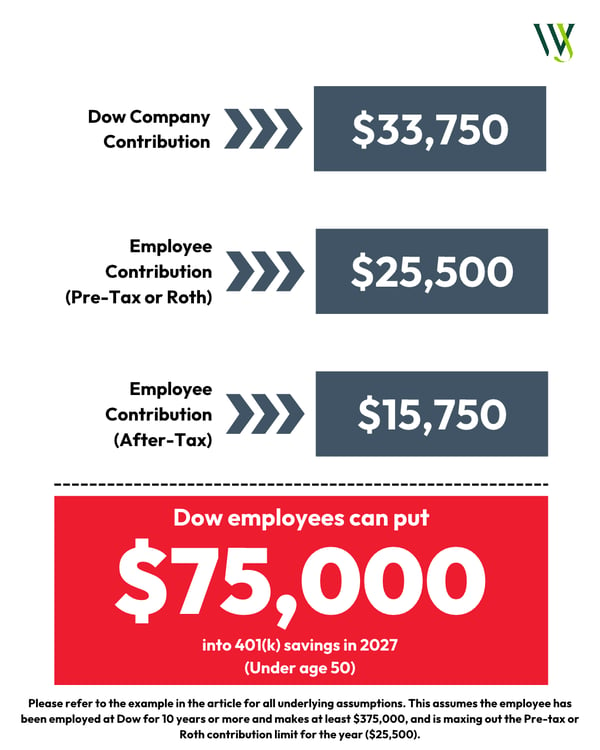
If you’re under age 50, the total IRS limit for 401(k) contributions in 2027 from employee or employer contributions is $75,000. Here's how it breaks out:
- In Pre-tax or Roth: Employees under age 50 can contribute up to $25,500 across the two sources.
- In Non-Roth After-Tax Contributions: Employees may also contribute another $15,750 in after-tax contributions for 2027, assuming maximum matching dollars from Dow.
- Dow's Company Contribution: Dow contributes anywhere from 4-9% of an employee's compensation to their 401(k) each year. The maximum they can contribute in 2027 is $33,750 due to the IRS' income limits.
How Employees Can Max Out the Dow 401(k) if Aged 50-59 or Over Age 63
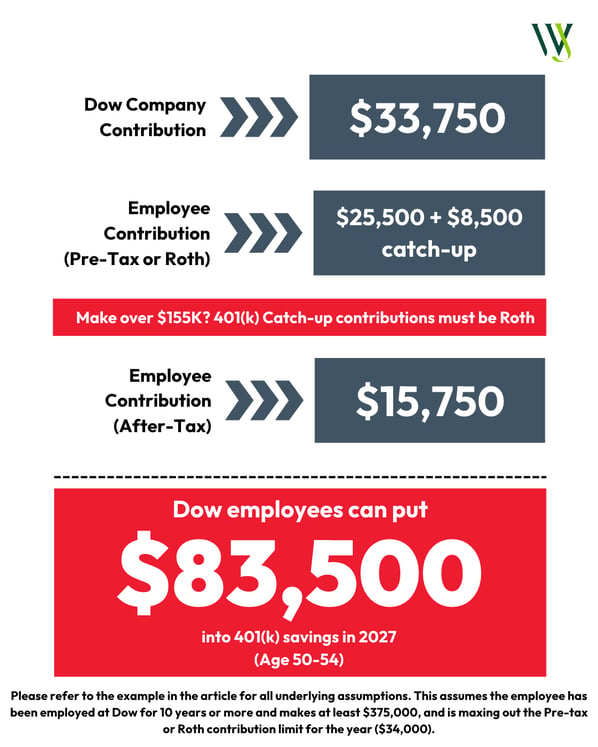
However, if you’re age 50-59 or 64 or older, the total IRS limit for 401(k) contributions in 2027 from employee or employer contributions is $83,500, which could be broken out as follows:
- In Pre-tax or Roth: Employees in these age brackets can contribute up to $34,000 across the two sources, thanks to an $8,500 catch-up allowance.
Following the passage of SECURE Act 2.0, catch-up contributions must be designated as Roth contributions for individuals whose prior-year FICA wages from Dow exceeded $155,000. This income threshold is indexed annually for inflation. - In Non-Roth After-Tax Contributions: Employees may also contribute another $15,750 in after-tax contributions for 2027, assuming maximum matching dollars, regardless of age.
- Dow's Company Contribution: Dow contributes anywhere from 4-9% of an employee's compensation to their 401(k) each year. The maximum amount Dow will contribute to an employee's ESP in 2027 is $33,750 due to the IRS' income limits.
In addition to the 401(k), there are valuable savings opportunities in vehicles such as the Backdoor Roth or HSA (which has additional catch-ups once you reach age 55).
If you’re maxing out all of these sources alongside the backdoor Roth and full HSA contribution limit for families with an individual catch-up, you could save up to $102,100 in tax-efficient vessels in 2027!
How Dow Employees Can Max Out the Dow 401(k) if Age 60-63
Employees aged 60 to 63 in 2027, can contribute even more to workplace retirement plans thanks to legislation under Secure Act 2.0. Individuals in this age group have a higher catch-up contribution amount, indexed each year for inflation.
2027 Changes to 401(k) Contribution Limits for Those Ages 60-63 Under SECURE Act 2.0
Instead of the standard catch-up amount of $8,500 for individuals aged 50-59 or 64+, savers aged 60-63 can leverage a catch-up amount of $11,750 in 2027 to boost their retirement savings. Here's how it breaks out across sources:
- In Pre-tax or Roth: Employees in these age brackets can contribute up to $37,250 across the two sources. Thanks to the newly instated $11,750 catch-up amount, individuals can contribute $3,250 more than if they only had the standard over 50 catch-up of $8,500.
- In Non-Roth After-Tax Contributions: Employees may also contribute another $15,750 in after-tax contributions for 2027, assuming maximum matching dollars, regardless of age.
- Dow's Company Contribution: The maximum amount Dow will contribute to an employee's ESP in 2027 is $33,750 due to the IRS' income limits.
This change provides a valuable opportunity for older employees to enhance their retirement savings as they approach retirement. Employees in this 4-year age bracket maxing out their ESP 401(k), a family HSA with an individual catch-up, and a backdoor Roth can save up to $105,350.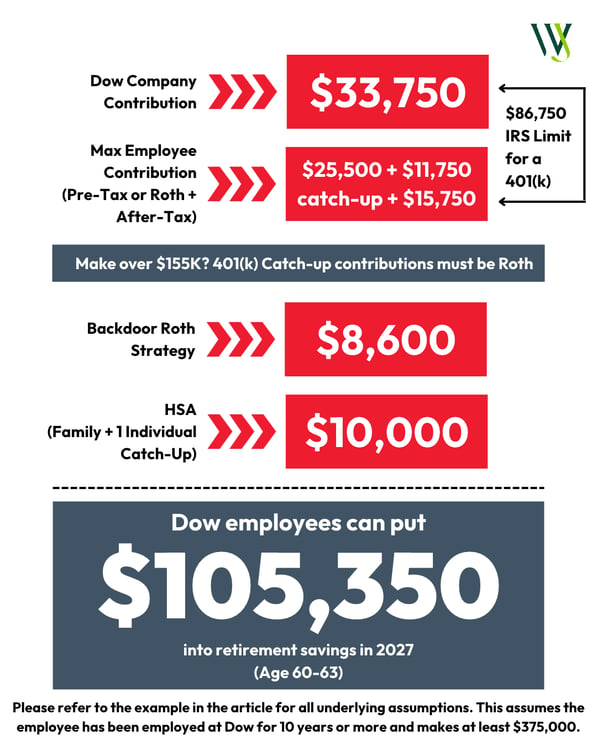
Savings Strategies Dow Employees Can Use to Save on Taxes
Roth accounts are one of the most effective ways to grow wealth for the future because your money grows tax-free. Contributions are made with after-tax dollars, so when you retire, you can withdraw both your contributions and earnings without owing taxes. For many Dow professionals, this helps create flexibility in retirement by balancing taxable and tax-free income and keeping more of what they’ve worked hard to earn.
Backdoor Roth Contributions if You Can't Directly Contribute to Roth IRA
The IRA contribution limit for 2027 remains $7,500 ($8,600 if age 50 or older). Though many high-income earners are prevented from directly contributing to a Roth IRA, many Dow employees can take advantage of the backdoor Roth strategy to get more saved in Roth each year. This strategy is nuanced and can cause more harm than good if enacted poorly, so be sure to discuss it with a financial advisor if you want to incorporate it into your financial plan.
Using a Mega Backdoor Roth with After-Tax 401(K) Contributions
Dow employees can put after-tax contributions into their 401(k) to maximize savings after the company match. If you are contributing after-tax dollars to the Dow 401(k), you can roll out the after-tax funds annually to a Roth IRA to take advantage of the mega backdoor Roth strategy for additional tax savings over time.
Dow Employees Can Maximize Benefits with a Health Savings Account for Tax-Optimized Savings
A Health Savings Account (HSA) is often an underutilized benefit that provides a unique triple tax advantage:
- Tax-Deductible Contributions: Contributions made to an HSA are tax-deductible, which means they lower your taxable income in the year you make the contribution. This can reduce your overall tax liability. In 2027, Dow employees can contribute up to $4,500 to an HSA for individual coverage, or $9,000 for family coverage. If you’re 55 or older and not on Medicare, you can add $1,000 more, so the most you can put into one family HSA is $10,000. If both spouses are 55 or older, the second spouse’s extra $1,000 has to go into a separate HSA in their own name, for a family total of $11,000.
- Tax-Free Growth: You can invest the funds in your HSA, and any earnings or capital gains are tax-free as long as they remain in the account. This allows your savings to grow over time without incurring taxes.
- Tax-Free Withdrawals for Qualified Medical Expenses: When you use the HSA funds for qualified medical expenses, the withdrawals are entirely tax-free.
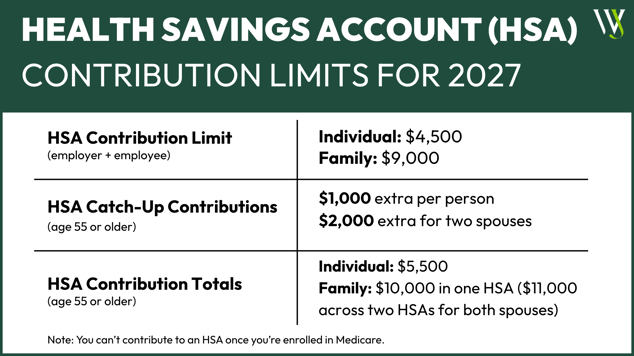
When using an HSA as a retirement fund, Dow employees can benefit from both tax deductions and tax-free growth, making HSAs a valuable tool for long-term savings and retirement planning.
High earners should use both plans strategically – what do savings amounts look like if you max out the 401(k), leverage the backdoor Roth, AND max out your HSA in each situation?
| Source | Under 50 | Age 50-54 | 55-59, 64+ | 60-63 |
|
Fully maxing out all 401(k) sources
|
$75,000
|
$83,500
|
$83,500
|
$86,750
|
| Backdoor Roth |
$7,500
|
$8,600
|
$8,600
|
$8,600
|
|
HSA (family, +1 catch up where applicable)
|
$9,000
|
$9,000
|
$10,000
|
$10,000
|
| Total Retirement Savings | $91,500 |
$101,100
|
$102,100
|
$105,350
|
What If You Make Over the 401(k) Compensation Limit in 2027?
The annual compensation limit for 2027 has increased from $360,000 to $375,000. If you make over $375,000 in base and bonus compensation for 2027, remember to ensure you max out your Dow ESP 401(k) contributions before earning $375,000. After you earn $375,000 in income, you and Dow can no longer contribute to the 401(k) for the remainder of the year.
Get a Tailored Savings Plan from an Advisor with Specialized Dow Benefits Knowledge
The 2027 limit adjustments will be advantageous for super-savers at Dow, and it is important to make the most of these changes.
At Willis Johnson Wealth, we work with our Dow clients to take advantage of backdoor Roth IRAs and facilitate after-tax rollouts from the 401(k) to help optimize retirement savings. If you have any questions about the 2027 contribution and compensation limits, please contact your advisor or schedule a free consultation with one of our Dow benefits specialists.